Free GPT API: The Real Routes to OpenAI Models Without Paying
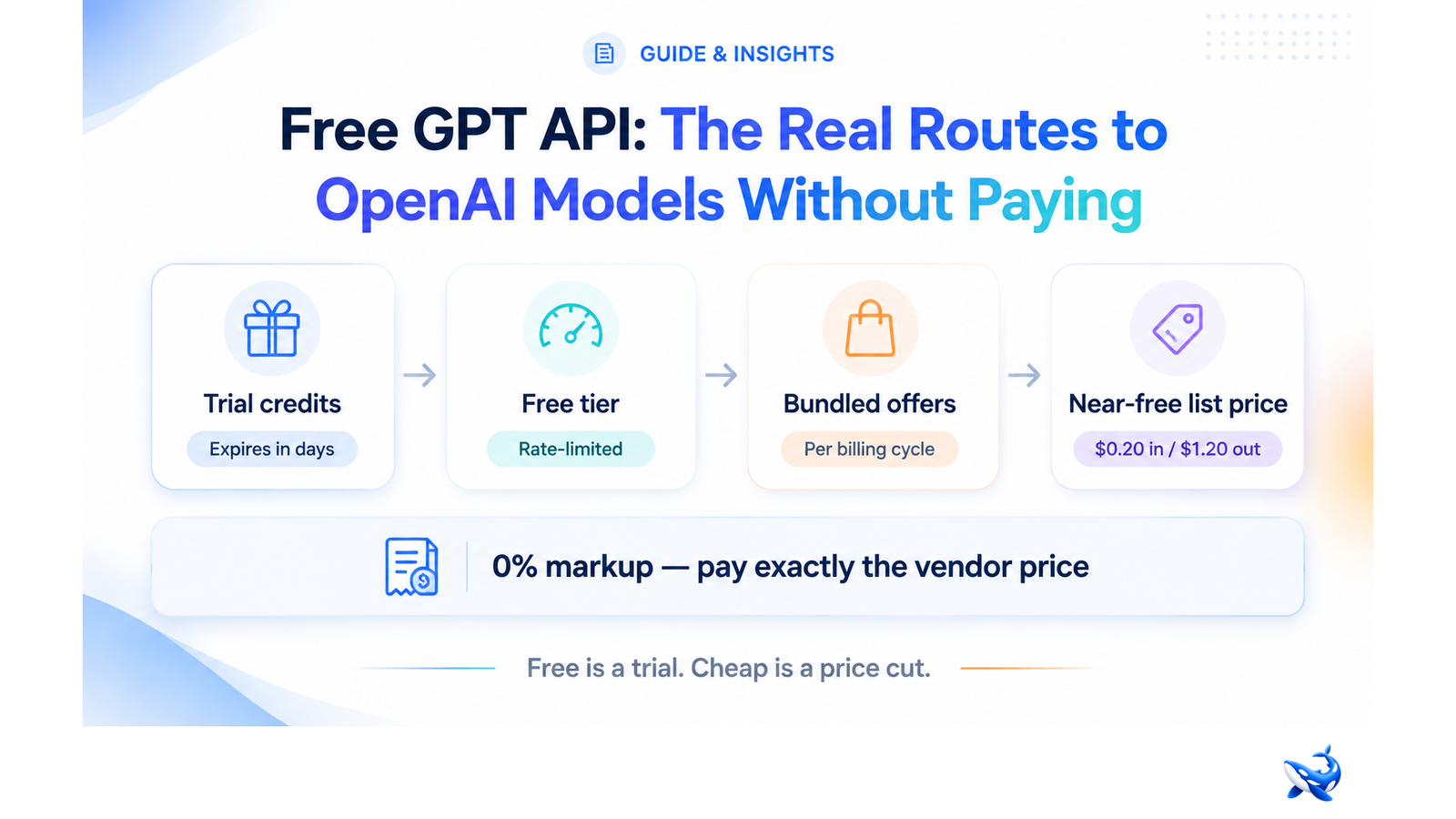
A free GPT API is not a perpetual OpenAI tier, and the honest version of this search is shorter than the results suggest: every real $0 route to GPT-class models is a trial credit, a rate-limited free tier, a bundled offer, or the fact that OpenAI has cut list prices so far that near-free is now the default. The free GPT API question is really a pricing question, and the answer changed when OpenAI slashed rates on the GPT-5.6 family — the cheapest GPT-class access is already close to zero, and a 0% markup router passes that price through untouched — the exact numbers you can verify on the live rate card for GPT-5.6 Sol, the family’s flagship.
Search “free GPT API” and the results follow a script: pages promising unlimited free access, keys that never expire, and mirrors running OpenAI models for nothing. Most of those are trials in disguise or rate-limit tricks that die by the second request. What people actually want is simpler — test a GPT-class model, run a script against it, or ship a product without the API bill becoming the business model — and all three are reachable at $0 or near-$0. Just not the way the search results describe it.
OpenAI cut list prices so far that “free” is mostly beside the point
OpenAI’s 2026 pricing did more for the free-GPT-API problem than any trial credit ever could. On the GPT-5.6 family, the vendor cut list prices hard; the Luna model dropped roughly 80% to $0.20 per million input tokens and $1.20 per million output tokens (vendor-reported figures, checked August 22, 2026). At that rate a full request costs a fraction of a cent — the same order of magnitude as the rate-limited free tiers that used to be the only route to paying nothing. The point is not that the API is now free; it is that the gap between free and near-free has closed to the width of a rounding error.
These are vendor figures because they move on OpenAI’s schedule, not anyone else’s. Before you trust a “free GPT API” claim, check the current rate card: the model you want may already be cheap enough that “free” is a worse deal than a stable, rate-unlimited key at list price.
Concretely, a $0.20-in / $1.20-out rate card changes what you can do at $0. A debugging loop that used to eat an entire free-tier allowance now costs less than a cent per round-trip; a batch job that once justified a paid subscription can run on the list price alone. For hobby projects and internal tools the math is trivial — spend a dollar and you have more GPT-class capacity than any trial credit ever granted. The hunt for a free GPT API is, in most cases, already over; the hunt for the current rate card is what remains.
The four $0 routes to GPT-class models
The legitimate routes all cost nothing up front, and all but one of them end.
| Route | What you actually get | What caps it |
| Trial credits | A small credit balance on a new API account for testing | Days to weeks; burns fast on output-heavy work |
| Rate-limited free tiers | Capped API or chat access that costs $0 | Request ceilings and speed throttles, sometimes silent |
| Bundled offers | Credits included in a platform plan you already pay for | Refreshes per billing cycle, never stacks forever |
| Post-cut list pricing | GPT-5.6-family models around $0.20 in / $1.20 out | Nothing but your prompt volume |
Trial credits are the classic entry point: a small balance, a deadline, and a strong incentive to test hard early. Rate-limited free tiers get you scripted access at $0, but the ceilings are the product — you are capped by design, and the cap can vanish when the offer ends. Bundled offers are the quietest route: usage folded into a platform plan you already pay for, so the marginal cost of a GPT-class request is literally zero until the cycle resets. None of these is free forever, and none of them should be the foundation of a product.
The fourth row is different, because it has no cap and no expiry. When the list price itself is $0.20 per million input tokens, “free GPT API” stops meaning “find a subsidy” and starts meaning “pay a price so small it does not matter.” That is the route worth building on.
The practical rule is to match the route to the job. Trial credits suit a one-time evaluation of a single model. A rate-limited free tier suits a demo that runs on a schedule you control. Bundled offers suit teams that already live inside a platform plan and want zero marginal cost for occasional calls. And the post-cut list price suits anything that needs to keep running — a script, a cron job, a production endpoint — because it is the only $0-level route without a timer.
Free vs capped: read the fine print before you celebrate
The difference between free and near-free matters in only one direction: caps. A free tier that throttles you to one request a minute is worthless for a script that needs a thousand. Trial credits that expire mid-project turn an evaluation into a race. The post-cut list price has neither problem — you pay pennies and get the full rate card, with no ceiling and no deadline.
So the honest test for any “free GPT API” offer is a two-question check. First: what is the cap — requests per day, tokens per month, or a credit balance with an expiry date? Second: what happens when the cap hits — a soft throttle, a hard stop, or a bill? Offers that answer with a soft throttle usually survive; offers that cannot answer are the ones to skip.
What a router changes when the price is already near-free
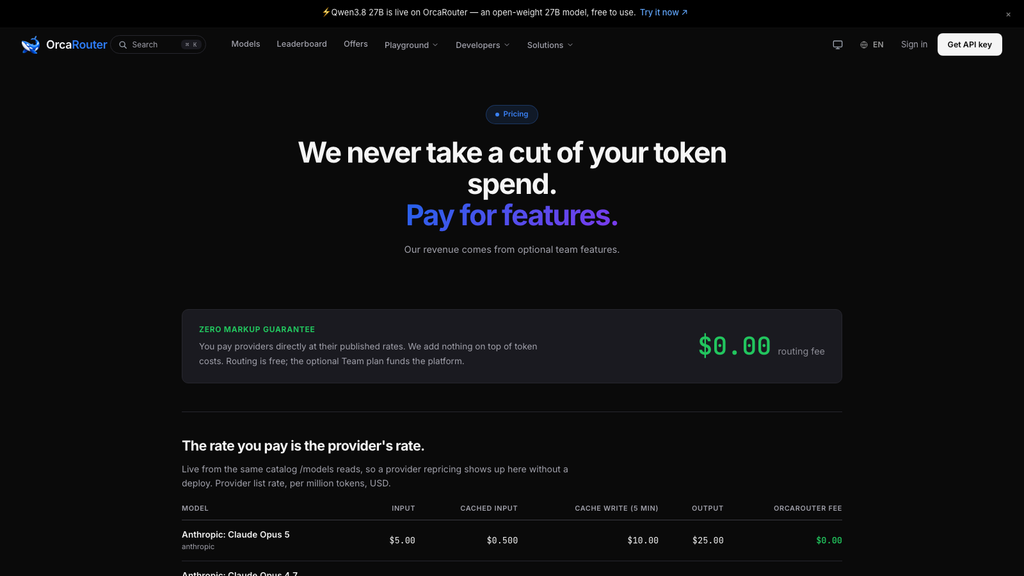
Once the rate card is small, the routing decision changes shape. OrcaRouter is a case in point: it passes provider list prices through at 0% markup, so the $0.20/$1.20 Luna rate is the rate you pay — provider price, no hidden add-on, with receipts for every request. One API key reaches 200-plus models across every major provider, requests are graded in under a millisecond and routed to the cheapest model that meets your standards, and automatic failover keeps a provider stumble from becoming a failed request.
That matters for the free-and-near-free framing in a specific way. After OpenAI’s cuts, the cheapest GPT-class access is already close to zero, and list-price pass-through means you pay exactly that — no intermediary premium to undo the vendor’s discount. For genuinely $0 work, OrcaRouter also keeps a free tier and offers you can claim on the offers page; for everything else, the post-cut list price is the price.
The takeaway
“Free GPT API” resolves into four honest answers, and only one of them scales. Trial credits, rate-limited free tiers, and bundled offers all get you GPT-class access at $0 — and all of them end, by design. The post-cut list price, at $0.20 in and $1.20 out for Luna, is the answer without the expiry date: after OpenAI’s own cuts, the cheapest GPT-class access is already near-free, and the smartest $0 strategy is to stop hunting subsidies and start checking rate cards. A router that passes list prices through at 0% markup makes the math transparent — one key, 200-plus models, and exactly the vendor’s number on the receipt.
Sourcing note: the GPT-5.6 family price cut and the Luna $0.20-per-million-input / $1.20-per-million-output list price are vendor-reported figures, checked by OrcaRouter on August 22, 2026. OrcaRouter’s 0% markup pass-through, one-key access to 200-plus models, sub-millisecond request grading, automatic failover, and free tier and offers are OrcaRouter’s own product data, verified on August 22, 2026. The characterization of the four $0 routes (trial credits, rate-limited free tiers, bundled offers, post-cut list pricing) is OrcaRouter’s analysis of the vendor’s published pricing.