100GBASE-ZR4 in Gradual Network Expansion: A Practical Step Instead of a Leap
Upgrades Don’t Always Happen All at Once
When networks need more bandwidth, the conversation often jumps straight to the biggest possible upgrade. Move everything to 100G, maybe even higher, and be done with it. That sounds efficient, but real environments rarely work that way.
Most networks grow in stages.
Some links become congested earlier than others. Some sites need more capacity, while others are still running comfortably. Budget cycles don’t always line up with technical needs either. So instead of one big upgrade, you get a series of smaller steps.
That’s where 100GBASE-ZR4 starts to fit in—not as the final destination, but as a very practical step along the way.
Defined under the IEEE 802.3, ZR4 modules support 100Gbps transmission over single-mode fiber up to around 80 kilometers. That reach makes them suitable for long-distance links, but what makes them interesting is how they can be introduced without completely changing the network around them.
Adding Capacity Without Rebuilding Everything
One of the challenges with long-distance upgrades is that they often involve more than just swapping modules.
In many cases, moving to higher-capacity links requires additional transport equipment, changes in network architecture, or new operational processes. That can slow things down, especially if only a few links actually need the upgrade.
ZR4 offers a different approach.
Because it works as a pluggable module, it allows you to increase bandwidth on specific links without introducing a full optical transport layer. You don’t need separate transponders or complex wavelength management systems for basic point-to-point connections.
You upgrade the endpoints.
That makes it easier to target problem areas first, instead of redesigning the entire network.
Where This Kind of Upgrade Makes Sense
In real deployments, this approach shows up in places where demand is uneven.
A company might have multiple data centers, but only some of them require high-capacity interconnects. Maybe one site handles backup and replication traffic, while another mostly serves local users.
Instead of upgrading every link, they focus on the ones under pressure.
100GBASE-ZR4 modules allow those specific connections to scale up to 100G over long distances, while the rest of the network continues operating as before.
You see something similar in telecom or regional networks. Certain aggregation points handle more traffic than others, and those links need reinforcement sooner.
Again, the upgrade happens selectively.
And ZR4 fits that selective approach quite well.
What Deployment Feels Like on the Ground
From a practical standpoint, deploying ZR4 modules doesn’t feel very different from working with shorter-reach optics.
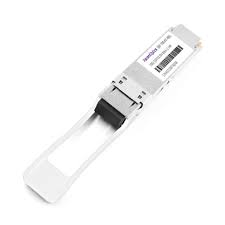
You install the module into a QSFP28 port, connect the fiber, and bring the link online. There’s no separate system sitting in between, no extra configuration layers to worry about in basic setups.
That simplicity matters, especially when upgrades need to happen quickly.
Teams don’t need to learn entirely new workflows. They can apply the same operational habits they already use for other Ethernet optics.
Of course, the longer distance means the optical budget becomes more important. Fiber quality, connector loss, and overall link design need to be checked more carefully.
But those are planning considerations, not operational complexity.
Living With ZR4 Over Time
Once the link is up and running, ZR4 modules tend to behave in a familiar way.
Monitoring tools provide the usual data—optical power levels, temperature, interface status. Over time, these values remain relatively stable unless something physical changes in the link.
Because of the longer reach, there’s less margin for error compared to shorter-distance modules. Small issues that might go unnoticed at 10km can become more visible at 80km.
But once the link is properly set up, stability is generally not a problem.
From an operations perspective, the experience feels closer to standard Ethernet optics than to more complex transport technologies.
That consistency reduces the effort required to maintain the link.
Why It Doesn’t Replace Everything Else
Even though ZR4 can handle long distances, it doesn’t replace every other optical solution.
In some environments, coherent optics provide better scalability and efficiency, especially when multiple wavelengths need to share the same fiber. In others, shorter-reach modules are more cost-effective for links that don’t need extended distance.
ZR4 sits somewhere in the middle.
It’s best suited for point-to-point connections where you need high bandwidth over a long distance, but don’t want to introduce additional layers of complexity.
That’s a fairly specific use case—but it’s a common one.
A Role That Fits Gradual Growth
As networks continue to evolve, not every upgrade will be immediate or uniform.
Some parts will move faster. Others will take longer.
Technologies like 100GBASE-ZR4 exist because of that uneven growth. They allow networks to scale where necessary without forcing a complete transformation.
Over time, some of these links may be replaced by more advanced solutions. But until that happens, ZR4 fills an important gap.
It keeps things moving forward without making everything more complicated.
Conclusion
100GBASE-ZR4 provides a practical way to introduce high-capacity, long-distance links into networks that are evolving gradually rather than all at once. By enabling 100G transmission over up to 80 kilometers of single-mode fiber without requiring complex transport systems, it allows targeted upgrades where they are most needed. Its familiar deployment model and stable operational behavior make it easier to integrate into existing environments, helping organizations expand bandwidth without disrupting the overall network structure.